Tuesday, May 26, 2009

My Art on Portal Wisconsin's Online Art Gallery

I just received notice that my artwork has been juried onto Portal Wisconsin's online art gallery. If you are interested in seeing my work in this gallery, please click on this link:

http://www.portalwisconsin.org/online_gallery_artist.cfm?artist=1115&sort=name

It is an honor to be included in this wonderful online gallery. Many opportunities have come to artists at this gallery, and I am grateful to be selected. It is a privilege to have my artwork posted alongside that of so many other amazing artists. Feel free to check out the site and browse all the wonderful art!

Friday, May 22, 2009

It Takes 300 Paintings to Reach Perfection

I had a college professor that insisted that the average artist had to complete at least 300 paintings before they would have reached an acceptable skill level. He would walk around the class and say to different students, " You're doing good, in about 200 more paintings, you will probably have it." He was always met with overwhelmed looks of desperation as the students mentally calculated how much longer they had to toil before they "had it".

I had the same feelings as the rest of the students. My only consolation was that when everyone else needed 200 more paintings (some 250 or 275), my professor stated that I only needed about 150 more. At first I wondered why he would say this to his students, who just wanted to express themselves through paint. Now I look back at my paintings I did in college and I have to laugh. It is true. An artist does need several hundred paintings under their belt for them to reach an acceptable skill level.

Many young aspiring artists do not understand the hard work, and stamina that go into becoming a skillful artist. The very first drawing class we took in the BFA program was designed to weed out those students that did not have the drive, the energy, or the motivation to be successful as an artist. That beginning drawing class was an essential milestone for any fine art student. The workload was heavy, the teacher was tough, and the students dropped like flies. Most of the students that made it through that first class went on to graduate with their Bachelor's of Fine Art and careers as fine artists.

I'm not sure if I've reached the 300 painting milestone yet, but I do know that I am leaps and bounds better than I was when I first started. It is all about hard work, education, and motivation!

Saturday, May 16, 2009

Ablaze: Original Oil Painting by Dena McMurdie

Ablaze - $100
8 x 10
Copyright Dena McMurdie 2009

I recently finished this small painting of a brilliant red tree near the lake shore. The colors of the leaves in Wisconsin during the fall are absolutely spectacular, and I wanted to capture it in paint. This painting almost has a Japanese feel to it. I kept the brushstrokes loose, to maintain my impressionistic look, and I used a simple split complement color scheme of red, blue, and neutral green.

If you are interested in this piece or any other painting on my site, please contact me by clicking on the link below. It will take you to a contact form on my website.
My family and I will be staying the summer in Colorado. I will be taking my paints with me, but all of my existing work will stay here in Wisconsin until we come back. Keep checking in to see new artwork all during the summer!

Thursday, May 14, 2009

85th Annual Hoosier Salon Exhibition Jury Process

I just returned home from jurying the 85th Annual Hoosier Salon Exhibition in Indianapolis, Indiana. It was quite the experience! When we arrived at the jurying site, we were welcomed by the site of 15 large crates full of artwork in addition to the large selection of sculpture. This photograph was taken near the end of our jurying process, when there were only a few crates left to go through.

There were nearly 600 entries of art for this competition, and it was a daunting task to go through all of them. Dean Mitchell (the other juror) and I had the physically easy part however. Volunteers were in charge of moving the artwork around into the different categories. We were able to look through every piece of art on the first day and separated them into three "piles" of yes, no, and maybe. The second day we spent going through the maybe pile and deciding yes or no on them. Then we searched through the entire yes category and pulled out pieces that we felt were outstanding. Once we had those all set up so they were easy to see, we assigned awards to the deserving works of art.

It was an exhausting process, but it went well. Dean and I agreed on most pieces that we saw. There were quite a few that we disagreed on and were able to discuss the different qualities or problems that the painting had. In the end, we both agreed upon every piece that was included in the show, and all the pieces that received awards.

This is a photo of Dean and I at the very end of the process, when we had decided on all the pieces to be in the show.
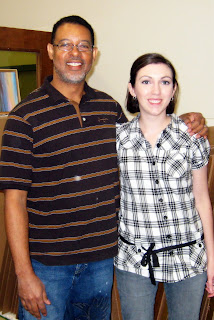
This is a photograph of Dean, three of the wonderful volunteers that came to help with moving artwork around, and me on the end.


This was a wonderful jurying experience. I enjoyed discussing the works with Dean and occasionally bantering back and forth on pieces that we did not agree on. When all was said and done however, we chose the best work - regardless of medium or genre, the best artwork was included in the show. And that is what juried shows are all about, selecting and rewarding the best artwork that is brought out to be judged.


Wednesday, May 6, 2009

Did Van Gogh Really Cut Off His Own Ear?

Two historians are now claiming that Van Gogh lost his ear in a fight against fellow artist Paul Gauguin. The new story they have come up with is that the two artists got into a physical dispute outside of a brothel. During the scuffle, Gauguin pulled out his sword to defend himself and chopped off Van Gogh's ear. The two artists made a pact of silence, and neither one of them broke it. To read the full article on this story, visit http://abcnews.go.com/International/Story?id=7506786&page=1. It is quite a fascinating new discovery.

I have long been a fan of Van Gogh. His work is full of emotion. His bright colors and impressionistic style have been a source of great inspiration and influence for me. I especially love his charcoal drawings of the peasants. There is an emotional connection to his work that is nearly tangible. How fascinating this new theory is! To think that the mentally unstable, and emotionally erratic artist that has been famed the world over for his self-mutilating act, may not have even done it! There is no way to know for sure if Van Gogh cut off his own ear or if Gauguin did it for him. I personally believe that Van Gogh was definitely capable of cutting off his own ear. He suffered from epilepsy, depression, and passionate emotions. After all, he did shoot himself. On the other hand, Gauguin was not known for his relaxed and easy going demeanor. Whether or not Van Gogh was a self-mutilator, or if Gauguin was acting in self defence will remain a mystery.

I have heard an opinion by a fellow artist stating that Van Gogh may not have intentionally shot himself, either. The wheat fields where the incident happened are heavily inhabited with crows. The noise from the birds is enough to drive one insane. Van Gogh often carried a small pistol to scare the crows away while he painted. It is possible that he accidentally shot across his stomach, too distracted by the noise from the crows to realize that he was injuring himself. Once again, it is a possibility, but I am not quite convinced that it was an accident. How does one person have so many dramatic accidents in one lifetime?

Monday, May 4, 2009

Painting Advice: An Easy Way to Achieve Harmony in Your Paintings - Part III

This is the third and final post in my series, "An Easy Way to Achieve Harmony in Your Paintings". So far, we have covered the two main points (1) pick a limited palette and mix your own colors and (2) know your color wheel, choose a color scheme and stick to it.

This third tip is just as important as the other two: Put a little bit of every color into every color. Never use the paint directly out of the tube. It will look out of place next to all your other harmonious colors. A white object in the sunlight is not stark white, there will be a light yellow/orange tint to it. So take your white, add a little (very little) blue, a little yellow, and a little red, until you have a nice, warm white.

Adding just the teeniest bit of each color into every color will enhance your harmony, and create unity. You will have a better painting than if you haphazardly apply the paint directly from various pre-mixed tubes.

So remember, the easiest way to achieve greater harmony in your paintings is by following these three tips:

1. Pick a limited palette
2. Choose a color scheme and stick to it
3. Put a little bit of every color into every color

As you work these three ideas into the planning and execution of your painting process, you will find that your work improves almost instantly. But don't take my word for it. Try it and see!