Tuesday, April 28, 2009

Painting Advice: An Easy Way to Create Harmony in Your Paintings: Part II

A second way you can create harmony in your paintings is to know your color wheel, choose a color scheme, and stick to it.


Here is a basic color wheel. There are many, many color schemes to choose from. Some of my favorites are:


Monochromatic: With a monochromatic color scheme. You use one color for the entire piece, changing the values (lights and darks) as needed. I love monochromatic paintings because they allow you to create a mood and a feeling that are not quite as accessible with other color schemes. I used this color scheme in "Overlooking the Spread" to create a western feeling, one of a warm afternoon, with a young man overlooking his spread.


Complementary: A complementary color scheme uses two colors that sit opposite each other on the color wheel. Violet with yellow, green with red, and blue with orange. This piece, "Globe Gilias in Vase" is dominated by the green of the flower stems and vase, offset by the vibrant red background.

Analogous: This color scheme takes a section of colors sitting next to each other on the color wheel and uses them to create a harmonious, beautiful color arrangement. For this piece, "Autumn Glow" I chose to use yellow, yellow green, green, and blue green. Utilizing this simple color scheme, I was able to capture the feeling of light filtering through autumn kissed leaves in the evening. This color scheme lends itself to a harmonious color balance very easily.


As I said earlier in this post, there are many color schemes you can choose from. I merely illustrated a few of them. When you are planning your painting, choose a color scheme that will create the mood and the feeling that you are aiming for. Monochromatic color schemes allow you to focus on the subject and their story. Complementary color schemes make paintings pop, they exaggerate differences. Analogous color schemes allow you to appreciate the colors and enjoy the effects they create.

Remember, if you want to achieve greater harmony in your paintings, choose a limited palette, pick a color scheme, and stick with it. The results will amaze you!

Wednesday, April 22, 2009

Painting Advice: An Easy Way to Achieve Harmony in Your Paintings - Part I

Definitely the easiest way to achieve harmony in your paintings is to use a limited palette.
Choose one yellow, one blue, and one red. Use those for your entire painting, mixing all your other colors from those three, and PRESTO! You will have a harmonious painting. You will see an almost instant improvement in the color harmony in your artwork. Pre-mixed colors may be convenient, but they look out of place and the entire piece will not come together as a whole. Just something to think about.

Here is the palette that I use. Cadmium Yellow Pale, Ultramarine Blue, and Alizarin Crimson. I am not endorsing Windsor Newton. That is just the brand I use.

Notice that I have one yellow, one blue, and one red. I also have white and Burnt Umber. Notice that I have no black. That is not a mistake. I find that another great way to keep my colors consistently harmonious is to mix my own black. Pre-mixed black is very flat and boring. I use Ultramarine Blue, and add a little red, a little yellow, and a little Burnt Umber to create a colorful, rich black. It is darker than black from a tube and far more appealing.

Monday, April 20, 2009

Open Edition Fine Art Prints Now Available

I have made some of my paintings available as open edition prints. To see all the prints available, please either click on the link in the right column, or click HERE.

All of my prints are Giclee, and are printed on high quality printers. They are available on paper or canvas, and there are various sizes available.

Thursday, April 16, 2009

Misty - Original Oil Painting of a Miniature Horse


Misty - $450
9 x 12
Oil on Canvas Board
Copyright Dena McMurdie 2009

I just finished this piece last night. This is "Misty" a miniature horse. I chose a small format (9 x 12) and used mostly the same color throughout the painting. I love the effects and the mood that can be created by sticking to one or two main colors. Although this piece may appear to be entirely made up of different shades of brown, you may be surprised to know how many colors were used to complete it. If you look close enough, you will notice hints of blue, green, red, and violet throughout the composition.

I quite enjoyed painting this piece. I decided to paint it for an invitational show that is coming up soon. So wish me luck, as I send this image off to be judged into the exhibit!

Wednesday, April 15, 2009

Fun Quote for the Day

"Painting is a barely controlled disaster." - Skip Whitcomb

I love this quote! Once again, I got this from my good friends at Fine Art Views.

This article appears courtesy of FineArtViews.com by Clint Watson, a free email newsletter about art, marketing, inspiration and fine living for artists, collectors and galleries (and anyone else who loves art) . For a complimentary subscription, visit: http://www.fineartviews.com/

Tuesday, April 14, 2009

How Artwork is Priced

Well, mine at least.

I wanted to expound a little bit on the article I posted the other day. I mentioned that the article explains part of the reason that artwork is so expensive. That reason is the fact that so much effort, energy, and life go into a piece of art. The other reason that artwork is expensive, is that it is expensive to create, and expensive to sell. What many collectors don't know is that when artwork is purchased through most commercial galleries, 50% of the sale goes directly to the gallery. Even through other venues such as restaurants and resort lobbies, a hefty commission is deducted from the sale price. So, in order to arrive at a fair price for artwork, an artist must take many factors into consideration. They have to consider how much money is spent on creating a piece of art. For an oil painting such as the ones that I do, I must factor in the supplies (brushes, paint, canvas, easel, reference material, turpentine, razor blades, plastic drop sheet, paper towel, etc.), the space it takes up in my home, the phone expenses incurred from my business, travel expenses, camera expenses, model and costume fees, and all other overhead expenses. Once that is all added up (it is easiest to figure it out for the entire year), I figure out how many paintings a year I complete, divide the overhead by the expenses, and come up with my base price. It may surprise you how much this adds up to.

The last factor that must be considered is TIME. How much time goes into each piece of art. I don't know many professionals that would work for less than $60/hr or so. But very often, artists are earning $1/hr or sometimes even losing money on every transaction.

Once all the expenses and a reasonable dollar amount per hour are established and added up, that becomes the retail price. For consistency's sake, I like to set an established price for each size of painting that I create. Prices going up as the size goes up. That way, it makes my artwork more affordable for any budget.

So, collectors, now you know why art is so expensive. And artists, now you know how to price your artwork so that you are actually coming out ahead! You may not want to take the time to add up all your expenses, but it is the only way to set a fair price for your work. You may be surprised at how expensive it really is to create your art!

Thursday, April 9, 2009

Don't Discount the Abstract Art

All too often when I am talking with someone about art, they complain about abstract and contemporary art. They say, "Anyone can do that. I could do that. Why would I pay money for it?"

The problem with their logic is that they aren't doing it, the artist is. Many people don't understand abstract and contemporary art. They feel that there is no artistic ability, and no talent that goes into it. However, it is a lot of hard work. Not every one can be an abstract artist. There is a different mind-set that goes with being a non-representational artist, that is for sure. But consider this: did you ever think that perhaps the artist is extremely talented, and simply decided to take a new direction? It wouldn't be the first time that an artist broke away from the mainstream rhythm of society.

Take Picasso, for example. He is world renowned for his fabulous works of art. Yet I have heard countless people exclaim over his lack of ability. Picasso had plenty of ability. He was quoted to have said that at the age of a child, he could draw as well as Raphael. This is a portrait of his father that he did when he was twelve years old. If you had mastered your profession at the age of twelve, don't you think you would try branching out?

Picasso's work gradually became more and more cubist. You can see the simplified shapes and distorted figure beginning to take form in "The Old Guitarist".

"Guernica" is perhaps one of Picasso's better known pieces. You can see the shapes are extremely simple and the forms distorted to the point of excess.

One of the reasons that Picasso began to use cubism is because he was able to portray his message much clearer. In "Guernica" he was able to depict the horrible devastation of the town when the Nazis unexpectedly bombed the town with no warning. The emotion and horror is far more tangible using distorted, simplified shapes and symbolism than if Picasso had painted a lifelike rendering.

Wednesday, April 8, 2009

Article About the Spirit and Life of a Piece of Art


Autumn Brilliance - $450
9 x 12 Oil on Canvas panel
Copyright of Dena McMurdie, 2009

I signed up to receive Fine Art Views by Clint Watson. It is a free email newsletter on various subjects related to art. I absolutely love receiving these emails. They are insightful and informative. This particular article expresses the way I feel about my art. Rather than try to sum it up and ruin it, I thought I would just re-publish a part of it.

I cannot count the number of times I have been asked why original art is so expensive. This article explains part of the reason:

Create (v): to bring into being; to cause to exist; to form out of nothing.

So, artwork created by an artist exists. It is an inanimate being. The word 'being' has several definitions but usually connotes life of some sort. You may just consider it a matter of semantics, but I believe that original art has life. I don't speak of life in some abstract fashion, but rather in the same way any other living object exists. It has something much, much deeper than the physical attributes of an inanimate object. Although inanimate, art is a being. It speaks. It breathes. It communicates. It challenges us. It causes us to feel, to wonder, to dream, or cry. It can inspire. It can lift. Or it can degrade.

When your hands mold the clay or push the brush around - you are forming something out of nothing. The thoughts, feelings, passions, and emotions all come into play to influence how your hands work. Intuition and experimentation play off each other. Knowledge and curiosity work to transform your emotions into expressions. Skill is developed and then manipulated in just the precise manner to achieve the subtle effects desired by you. Through this effort you cause a work of art to exist. It is born in your hands. It has life. It is, in a true and literal sense, a creation. This is why it is so powerful. It is not simply another object. It was created. It was brought into being. It now exists.

There is something spiritual about the creation of art, just like our bodies are both physical and spiritual. The spirit gives us life, thought, and emotion, etc. Once we die, the spirit has left the body, but the corpse is still there. Yet without the spirit to give it life, the body will eventually decompose and cease to exist in human form. There are similar principles with art. There is the physical canvas (or wood or stone or bronze), but deep within is the spirit of the piece. You give it that spirit as you create the work. The spirit gives the piece life which expresses thought and emotion. Without the spirit, the piece is lifeless or dead. That is why a print will never have the same effect as an original. It will never be an original creation. It is an imitation.

Yes, a photograph of a person can capture one's character or personality, even emotion. But a photograph can never replace the actual person. It is merely a representation of the original. Likewise, a reproduction of a work of art can capture a portion of the magic or spirit of the art - but it can never replace it. Consider how powerful and moving an image in an art history book (or as a print) is. However, when one sees the original, something much more powerful is felt. The printed version pales in comparison. Visit a museum and you will find this to be true.

There is something intangible within artworks created with care by gifted hands. That quality is, in my humble opinion, life.

Sincerely,
Keith Bond

This article appears courtesy of FineArtViews.com by Clint Watson, a free email newsletter about art, marketing, inspiration and fine living for artists, collectors and galleries (and anyone else who loves art) . For a complimentary subscription, visit: http://www.fineartviews.com/

Tuesday, April 7, 2009

Profile

Dena McMurdie grew up in the breathtaking countryside of Alberta, Canada. She graduated from Brigham Young University-Idaho with a degree in fine art. Now she pursues her artistic passion from her home in Madison, Wisconsin. Dena is an award winning artist whose work has been collected in the United States, Canada, and Europe.

Dena’s art is about the small but life-changing moments of the human experience. When the turmoil of the world melts away, we are granted precious moments to reflect on the significant things in life. These moments are captured through the expressiveness of her art.

Monday, April 6, 2009

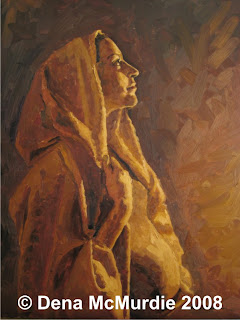
Expectations - Oil Painting of Mary, the Mother of Jesus


"Expectations" - 18 x 24
Oil on Canvas - Framed
SOLD
Copyright of Dena McMurdie 2009

*Please note that if you purchase this painting, it will not ship until October, 2009.
Much was expected of Mary; she was chosen to bear the Savior of the world. Much would be expected of the child she so lovingly carried in her womb. At times, I believe she felt overwhelmed with the role that was placed upon her. She must have often looked to our Father in Heaven for guidance, support, and encouragement. I imagine the Holy Spirit enveloping her in its warm embrace as she gazes heavenward in a silent prayer, asking for constant companionship as she prepares for the marvelous task that is rapidly approaching. What faith must be possessed by such a woman as Mary. She was so willing to take on whatever responsibility God gave her, standing steadfast and faithful until the end.

"Expectations" was accepted into the 8th International Art Competition hosted by the Museum of Church History and Art in Salt Lake City. It underwent two rounds of judging, the first digital, the second on the original painting. It is currently hanging in the Conference Center on Temple Square from March 20 - October 11, 2009.
Hundreds of people attended the opening exhibit.

I flew out to Salt Lake City to attend the opening reception myself. It was a wonderful experience. Hundreds of people milled around each piece of artwork, exclaiming in excitement when they discovered one that they loved. This picture is of my brother and me, standing beside my piece.

Thursday, April 2, 2009

Riding Through November - $450


copyright of Dena McMurdie 2009

Autumn in Wisconsin is one of the most inspirational experiences that an artist can have. Addicted as I am to being outdoors when the weather is nice, I naturally take my camera along to capture all the beautiful scenery. I love the fall because it gives me such wonderful reference for all of the studio painting that I do during the winter. This painting, "Riding Through November" was an absolutely stunning sight. A man on a bicycle slipped past me on the leaf covered path I was walking on. The trees were ablaze in their bright yellows and oranges.